Measures geomagnetic activity on a scale of 0 to 9. Higher values indicate Earth's magnetic field is being shaken by solar wind.
Velocity of particles leaving the Sun. Fast winds (500+ km/s) act like a blower that lights up the aurora.
A negative (South) Bz "opens the door" for energy to enter our atmosphere.
High density means more particles are hitting the atmosphere, making the aurora brighter.
Real-time estimate of total energy entering the atmosphere. Higher GW = bigger aurora.
Indicates overall solar activity. High numbers mean more solar storms.
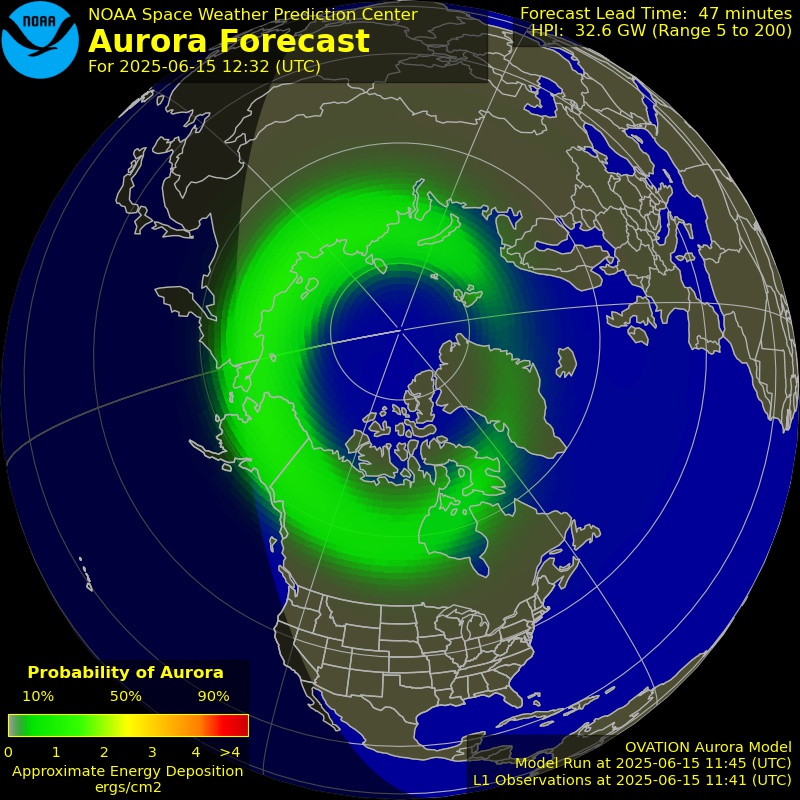
CONNECTING TO NOAA...
Data: NOAA OVATION-Prime Model. Percentages represent visibility probability overhead.
This endpoint provides the raw data for the OVATION Aurora Forecast Model.
Aurora Forecast: When Will the Sky Light Up?
To witness the fascinating natural spectacle of the Northern Lights, you need two things: patience and precise data. Our Live Aurora Forecast utilizes real-time data from NASA and NOAA to provide you with the best chances for a sighting.
How to Read Aurora Data?
The most important value for an aurora forecast is the Kp-index. It describes the disturbance of the Earth's magnetic field on a scale from 0 to 9. For observations in Scandinavia, a Kp value of 2 or 3 is often sufficient. However, if you wish to see the Northern Lights in mid-latitudes (like Germany), a Kp-index of at least 6 (G2 storm) or 7 (G3 storm) is usually required.
Influence of Solar Wind and IMF
In addition to the Kp-index, solar wind speed and the IMF (Interplanetary Magnetic Field) play a decisive role. A negative Bz value (the "open door") facilitates the entry of solar particles into our atmosphere. Combined with high proton density, the chances increase for the Aurora Borealis to become visible even at lower latitudes.